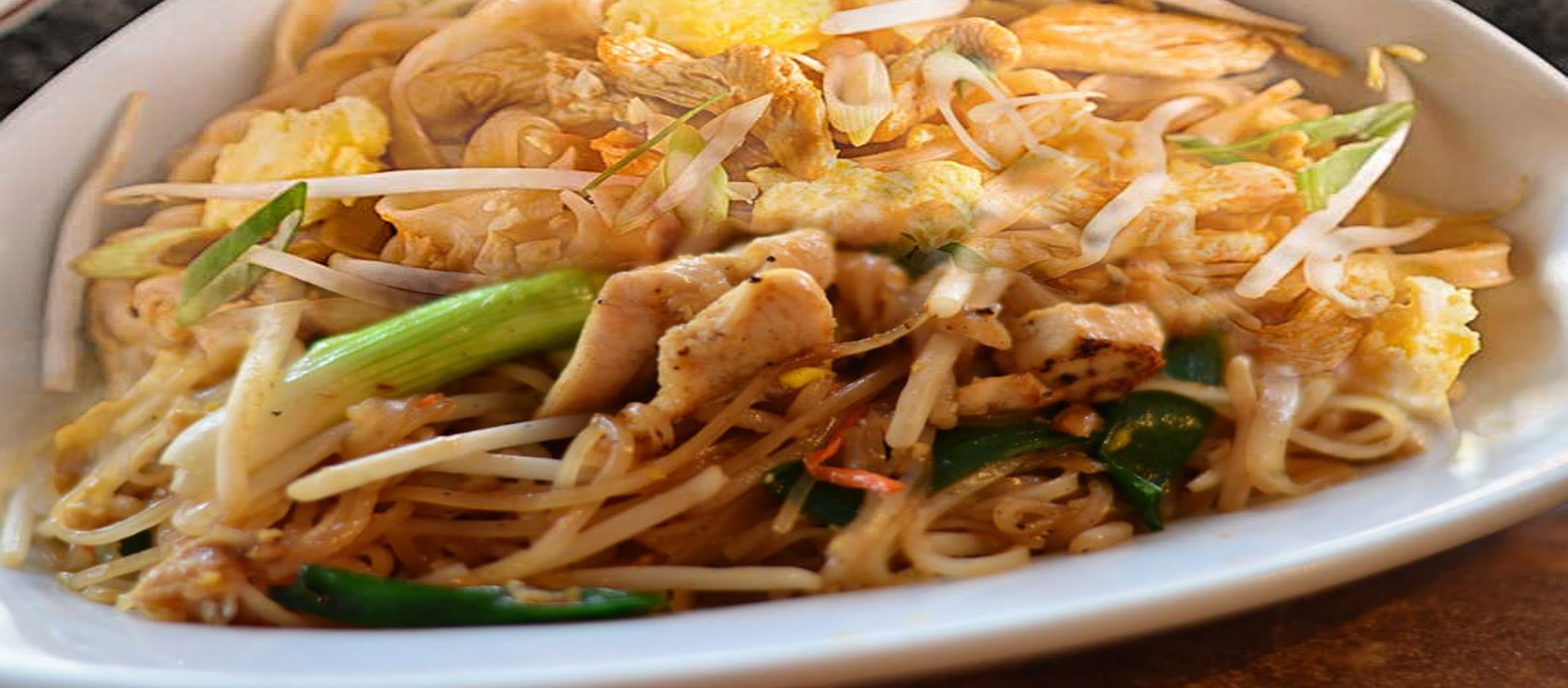
National Dish of Thailand Pad Thai

Pad Thai is a stir-fry noodle dish that is iconic in Thai cuisine. The dish originated during World War II when a rice shortage forced the government to promote noodles as a substitute

Servings

6 Person

Prep Time

60 Min

Cook Time

20 Min

Total Time

90 Min

12 oz.
dried rice noodles
4
eggs (beaten)
½ cup
distilled white vinegar
¼ cup
fish sauce
1 ½ tsp.
salt
1 cup
peanuts (coarsely ground)
2 cups
bean sprouts
2 tbsp.
tamarind paste
1 tbsp.
vegetable oil
½ cup
chives (chopped)
1 tbsp.
paprika
2
boneless, skinless chicken breasts (sliced into strips)
1
lime (cut into wedges)
1 ½ tsp.
minced garlic
White sugar

Pad Thai is a stir-fry noodle dish that is iconic in Thai cuisine. The dish originated during World War II when a rice shortage forced the government to promote noodles as a substitute. Today, rice noodles are used in the dish. Originally, pork was not used in Pad Thai because it was considered to be Chinese meat.

Directions for Preparing Pad Thai

  1. Soak the rice noodles in a bowl of water for about one (1:00) hour.
  2. Drain and set aside.
  3. Add ½ cup of white sugar to a saucepan.
  4. Add the fish sauce, vinegar and tamarind paste to the sugar, then whisk them all together over medium heat.
  5. Bring to a simmer, then remove from the heat and set aside.
  6. Heat one tablespoon of oil in a clean wok, then add the chicken strips and cook for about seven (0:07) minutes.
  7. Remove the chicken from the heat when cooked and set aside.
  8. Heat another tablespoon of oil in the wok and sauté the minced garlic in the oil.
  9. Add the eggs and scramble them.
  10. When the eggs are cooked, add the chicken strips and rice noodles.
  11. Toss to combine.
  12. Add the tamarind sauce mixture and 1 ½ tablespoon of white sugar.
  13. Season the Pad Thai with salt and toss to combine once more.
  14. Cook for about five (0:05) minutes until the noodles are tender.
  15. Stir in the peanuts and cook for an additional two (0:02) minutes.
  16. Transfer the Pad Thai to a serving dish.
  17. Garnish with bean sprouts, chives, lime wedges, and paprika.

Regional cuisines and historical influences

Thai cuisine is more accurately described as five regional cuisines, corresponding to the five main regions of Thailand:

Bangkok: the cuisine of the Bangkok metropolitan area, with Teochew and Portuguese influences. In addition, as a capital city, Bangkok’s cuisine is sometimes influenced by more dedicated royal cuisine. The tastes and looks of food in Bangkok have changed somewhat over time as they have been influenced by other cuisines such as Asian, European, or Western countries.

Central Thai: cuisine of the flat and wet central rice-growing plains, site of the former Thai kingdoms of Sukhothai and Ayutthaya, and the Dvaravati culture of the Mon people from before the arrival of Siamese in the area. Coconut milk is one of the major ingredients used in Central Thai cuisine.

Isan or northeastern Thai: the cuisine of the more arid Khorat Plateau, similar in culture to Laos and also influenced by Khmer cuisine. The best-known ingredient is probably fermented fish.

Northern Thai: the cuisine of the cooler valleys and forested mountains of the Thai highlands, once ruled by the former Lanna Kingdom and home of Lannaese, the majority of northern Thailand. This cuisine shares a lot of ingredients with Isan.

Southern Thai: the cuisine of the Kra Isthmus which is bordered on two sides by tropical seas, with its many islands and including the ethnic Malay, former Sultanate of Pattani in the deep south. Some food is based on Hainanese and Cantonese influences.

National Dish of Peru

Pad Thai is one of the most recognizable dishes from Thailand, but its rise to national prominence is relatively modern. The dish emerged during World War II, a time when Thailand faced rice shortages and economic pressure. To reduce domestic rice consumption and strengthen national identity, the government promoted rice noodles as an alternative staple. Pad Thai was actively encouraged as an affordable, filling, and distinctly Thai dish. Early versions of Pad Thai avoided pork, as it was culturally associated with Chinese cuisine. Instead, ingredients such as fish sauce, tamarind, dried shrimp, peanuts, and eggs were used to create a balanced combination of salty, sour, sweet, and savory flavors. Over time, chicken, shrimp, and tofu became common additions. Pad Thai also reflects Thailand’s broader regional and historical influences. While commonly associated with Bangkok street food culture, its flavor profile draws from Central Thai preferences for balance and refinement, alongside influences from Chinese cooking techniques such as stir-frying. Today, Pad Thai is enjoyed nationwide and internationally, representing both Thailand’s culinary adaptability and its modern food identity.

Per Serving (Approximate values)

% Daily Value
Calories serving
158 (kcal)
Total Fat
g
Saturated Fat
g
Unsaturated Fat
g
Trans Fat
g
Cholesterol
g
Sodium
g
Total Carbohydrate
g
Dietary Fiber
g
Sugars
mg
Protein
g
Values are based on standard ingredients and may vary

Related Recipe

34 Views
August 14, 2025
Lachcha Paratha is a popular Indian flatbread known for its crispy, flaky layers. Traditionally made with a mix of whole wheat flour and oil, this delicious paratha pairs perfectly with curries, yogurt, or even on its own with some butter.
539 Views
June 21, 2025
Shah Plov is a rich and aromatic Azerbaijani rice dish made with saffron rice, tender meat, dried fruits, and nuts, baked inside a crisp golden crust for a stunning presentation.
27 Views
December 17, 2023
Gado Gado is a well-known dish in Indonesia. It is a one-dish meal, similar to a salad. It is prepared with fresh seasonal vegetables, eggs, tofu, and ingredients native to Indonesia

User Area